How to Choose the Best Kitchen Countertops: 4 Keys from Selection to Install
October 28, 2026
Kitchen countertops make a big statement, but choosing them involves more than finding a slab you love. The material has to fit your household, the price has to fit your budget, and the finished pieces have to fit your cabinets. Then there’s the backsplash, the veining, the overhangs, and the fabrication process. No wonder a slab warehouse can feel overwhelming.
We’ve been through that selection process, and even as professionals, the number of choices can stop you in your tracks. The way to make it manageable is to make the decisions in the right order.
Start with your fabricator and budget, narrow down your material, and then work through the details that turn a beautiful slab into a finished kitchen. Here’s how that process comes together.
Key Takeaways
Choose your fabricator early to establish a realistic budget and guide slab selection.
Quartz offers consistency and minimal upkeep, while natural stone brings individual variation.
Use a statement island and complementary perimeter surfaces to stretch your design budget.
Accurate templates, approved slab layouts, and confirmed overhang supports help prevent costly surprises.
Choose Your Fabricator Before Shopping for Countertops
One of the best decisions you can make about kitchen countertops happens before you pick a color: choose your fabricator early.
A wholesale distributor such as MSI carries the slabs. Your fabricator helps turn those slabs into the pieces that will actually go into your home. That includes design coordination, final measurements, layout, cutting, finishing, and installation.
At MSI in Denver, homeowners will check in with their fabricator’s information so the distributor can communicate their selections to the right shop for pricing. That connection keeps everyone working from the same information.
A good fabricator also helps you answer practical questions before they become expensive surprises:
Which material price groups fit your budget?
How should the veining run through the kitchen?
Will your island overhang need support?
How will the slab be laid out before cutting?
When will templating, fabrication, and installation happen?
Bring a cabinet door or finish sample when selecting kitchen countertops. Seeing the materials together makes it much easier to judge whether the colors work. Trying to remember the exact warmth of your cabinets while standing in front of dozens of slabs is not a great design strategy.
Quartz or Natural Stone: Understand the Main Difference
The first big material decision for kitchen countertops is whether you want an engineered surface or natural stone. Most fabricators like MSI willy carry quartz, quartzite, granite, and marble, but quartz and natural stone offer very different kinds of predictability.
Quartz gives you more consistency
Quartz is a manufactured material made with quartz material and resin. That manufacturing process allows producers to create different colors, backgrounds, and veining patterns with a relatively consistent appearance.
If you like having more control over the finished look, that’s a real advantage. Quartz can offer the appearance of stone without the same degree of slab-to-slab variation.
There are plenty of choices, too. You can find soft whites, tans, grays, warmer hues, greens, and dark surfaces with contrasting white veins. Quartz kitchen countertops do not have to mean a plain white counter.
Alex at MSI described a shift from cooler colors toward warmer, cozier finishes. Taj Mahal natural stone is a popular example of that warmer direction, and quartz designs can offer a similar visual feel with more consistency.
That gives you a useful choice: do you want the character of a specific natural slab, or a manufactured design that stays closer to a repeatable look?
Natural stone gives you individual character
Granite, marble, and quartzite come from the earth. Their appearance reflects the conditions under which they formed, so the veining and color can change from slab to slab.
That variation is the appeal. Mother Nature does not work from a fixed design file.
For natural-stone countertops, pay attention to the actual slabs being considered for your project. A familiar stone name does not mean every piece will look identical. Even material from the same quarry can change as quarrying moves into different areas.
The decision is not simply which surface is prettier. It is whether you prefer consistency or one-of-a-kind movement, and how much maintenance you are comfortable taking on.
Match Countertops to Your Everyday Habits
Quartz is a popular choice for active households because it offers a durable, low-maintenance surface. One important benefit is that it does not require routine sealing.
But low maintenance does not mean you can forget about care altogether.
Keep a protective barrier between hot cookware and quartz. The resin component is the reason to be careful with direct heat. Use a suitable trivet or hot pad rather than putting a hot pot directly on the surface.
Clean spills promptly as well. In my own kitchen, I’ve noticed that something left sitting can leave a shadow that takes more effort to remove. That’s a good reminder to treat kitchen countertops with care, even when the material is designed for everyday use.
With granite, marble, or quartzite, discuss sealing requirements with your fabricator. Get care instructions for the specific stone rather than assuming all natural surfaces behave the same way. The Natural Stone Institute’s care guidance is also a useful reference.
Before making your selection, be honest about how you cook. If your kitchen regularly involves wine, lemon juice, grease, and a little enthusiastic food preparation, maintenance belongs in the decision right alongside appearance.
Know Your Price Group Before You Fall in Love
Here’s a budget tip that can save a lot of disappointment: ask your fabricator which price groups you should be shopping before walking through the warehouse.
At the MSI showroom discussed here, slabs are organized into groups running from one through nine. Those groups help narrow down the selection by price.
“For my own kitchen countertops, I focused on groups three through five and stayed away from the higher groups. That kept the search realistic. There is no benefit to falling in love with a group-nine slab if it is nowhere near your budget,” says David the Cabinet Guy.
Alex offered a rough planning guideline: moving up one group can mean approximately a 15% to 20% increase in the product price. That is a showroom guideline, not a universal installed-price formula. Your fabricator needs to price the actual project.
The useful question is not just, “What group is this?” It is, “Does this selection keep my project within the budget we discussed?”
Put the statement piece on the island
If you want dramatic kitchen countertops without using a premium material everywhere, concentrate the statement on the island.
That’s where people gather. It is also where lighting can bring out the movement and color in a striking slab. A bold island can create the wow factor while the perimeter stays quieter.
A dramatic slab can carry the design without covering every counter in the kitchen.
Choose a complementary perimeter surface that picks up a color from the island rather than competing with it. The materials do not have to be identical to belong together.
Spend where the visual impact matters most. A more restrained working perimeter can support the design and help preserve the budget.
Choose a Backsplash That Works With the Countertop
Once you’ve selected your kitchen countertops, move on to the backsplash. Trying to choose every finish at once can make the process unnecessarily difficult.
You have two broad directions:
Continue the countertop material up the wall. Quartz or natural stone can create a clean, consistent appearance.
Choose a separate tile backsplash. Tile adds an opportunity for color, texture, and a distinct design element.
Neither approach is automatically better. It comes down to the look you want and how you use the space.
One main consideration: a bold countertop and a bold backsplash can start fighting each other. If the slab has strong movement, a quieter backsplash often lets it stand out.
A smooth slab backsplash has fewer grooves and grout joints to deal with. If you choose natural stone, talk through care around cooking splashes. Whatever material you select, coordinate the application around the cooking area with your fabricator.
Approve the Slab Layout Before Cutting
A beautiful slab does not automatically produce beautiful kitchen countertops. Where the pieces are positioned on that slab matters.
At Colorado Countertops, the team demonstrated Slabsmith, a system that photographs the slab and creates a digital file. The shop can then arrange the countertop pieces over that image to evaluate veining, orientation, and flow.
Reviewing the layout helps confirm which parts of the slab will become the finished counters.
This is particularly valuable when you are paying for distinctive movement. You want the best part of the slab in the right place, with the grain running in the direction you expected.
The customer receives a layout for approval. If something does not feel right and the slab allows another arrangement, the shop can move pieces before cutting begins.
That approval step helps prevent a very disappointing moment: walking into the finished kitchen and realizing the stone looks nothing like you imagined.
Look Beyond the Slab: Fabrication, Finishing, and Safety
Once the measurements and layout are ready, the fabrication shop programs the cutting equipment. CNC machinery uses the project information to size the pieces and create openings, including sink cutouts.
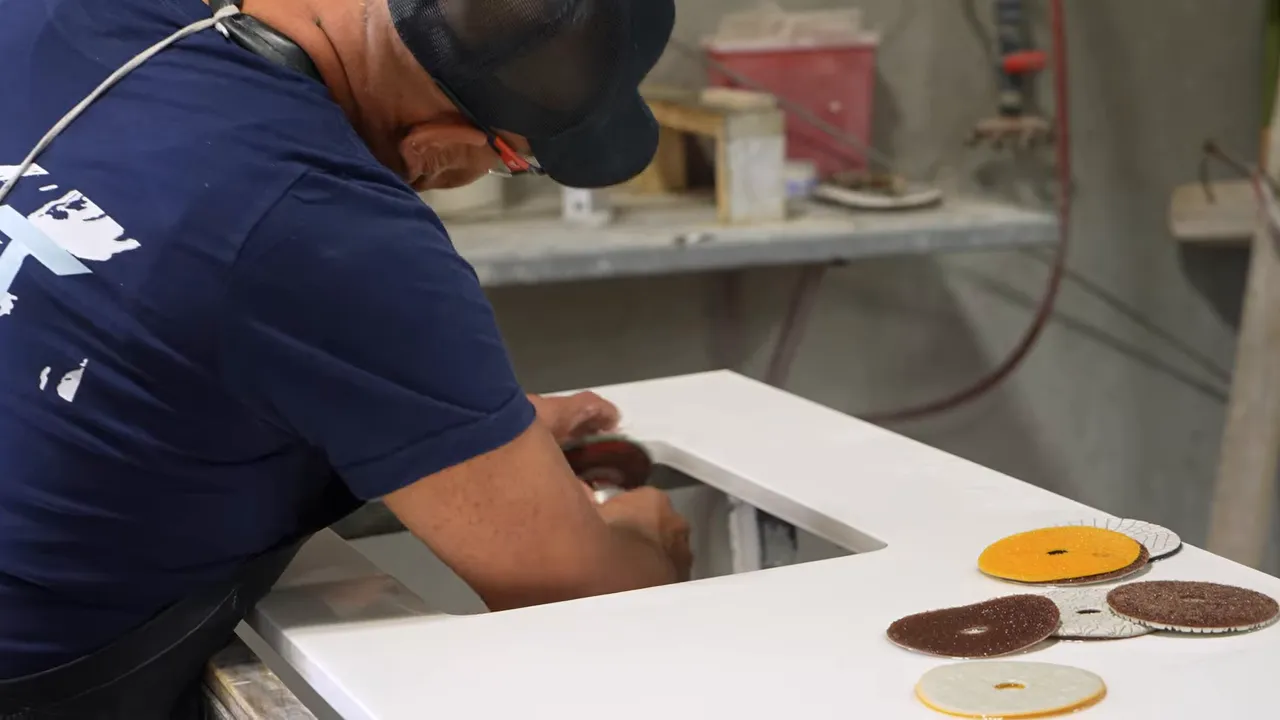
Automation handles a great deal of the work, but skilled finishing still matters. Technicians check the pieces, refine edge profiles, and polish cutouts. Different polishing grits help bring the edges to a finish that looks consistent with the surface.
There is an art to that final work. The goal is not simply a correctly sized piece. It is a finished surface with clean details and a uniform appearance.
Also ask how the shop controls dust. At Colorado Countertops, water is used during cutting and polishing, with drains and a filtration system that allows water to be reused. Those systems are an important part of the fabrication environment, not just housekeeping.
Stone fabrication requires serious attention to worker protection. For supporting information, OSHA’s crystalline silica resources explain the hazard and the importance of exposure controls. Ask about those controls rather than judging a shop only by its slab selection.
Get the Cabinets Ready Before Digital Templating
Choosing the surface is only part of getting kitchen countertops right. The final measurements need to reflect the installed kitchen, not just the original plan.
Before the templating appointment, your base cabinets should be fully installed and ready. Confirm readiness with your fabricator rather than assuming measurements can happen while the cabinet layout is still changing.
Digital templating captures the geometry the shop needs to fabricate the counters. Will from Doomore Templates demonstrated a laser-based process using Laser Products equipment and Raptor software.
The workflow includes several important steps:
Establish the measurement plane. Three reference points tell the software where the surface sits.
Capture centerlines. Sink and cooktop centers establish key locations.
Measure the walls. The system records the actual wall geometry.
Define the finished shape. Overhangs, radiused corners, and backsplash details are worked into the template.
Check the measurements. A tape measure provides a physical double-check.
Add shop notes. Labels identify sinks, cooktops, overhangs, and other fabrication details.
Walls are not always straight, and corners are not always 90 degrees. Capturing those conditions helps the shop produce kitchen countertops that fit the room, with less adjustment needed during installation.
The digital template records the countertop geometry for the fabrication shop.
The completed CAD file goes to the fabricator, where it is prepared in software compatible with the cutting equipment. Even with digital tools, the old rule still applies: measure twice, cut once.
Confirm support for seating overhangs
Do not treat an island overhang as just another dimension. It is also a support question.
Will discussed roughly 10 inches as a typical unsupported overhang for many materials, with some situations falling around 10 to 12 inches. But that is not blanket permission for your project. The slab, material specifications, and fabricator’s requirements determine what is acceptable.
Overhangs around 15 to 18 inches were identified as needing additional support. That could involve steel, cabinetry, or another approved solution. Confirm the support design before fabrication.
Keep the Whole Remodel Schedule Connected
Finally, be sure to choose a fabricator who communicates clearly and takes installation dates seriously. Delayed kitchen countertops can affect backsplash work, appliance coordination, and the trades scheduled afterward.
The strongest process connects every stage: an early fabricator conversation, a realistic budget, a material suited to your habits, accurate templating, an approved slab layout, and careful fabrication.
You do not have to choose the most expensive stone or use the same material everywhere. The right kitchen countertops are the ones that look right, work for your household, and arrive exactly as planned. Getting there is much easier when the details are settled before anyone starts cutting.
Choosing flooring for your kitchen can feel like one of the toughest decisions in the whole remodel. You find a color you like, then start comparing thicknesses, finishes, plank widths, and installation ...
The right kitchen appliance is the one that fits your cooking habits, available space, and budget. A restaurant-style range or panel-ready refrigerator can be appealing, but neither is automatically the best choice ...
We use cookies to improve your browsing experience, analyze site traffic, and serve personalized content.
By clicking “Accept,” you consent to our use of cookies as described in our
Cookie Policy.